Read an introduction to how the systems came about….
Nyaya
The system of logic established in the Nyaya Sutra by Gautama has been subsequently adopted by most other Indian Schools. Followers of this school (called Nyanikas) believed that release from the cycle of suffering could only be obtained through valid knowledge and went to great lengths to discern valid from invalid knowledge.
- Introduction to Nyaya
- The Nyaya Sutras – By Gautama
- Book 1: Chapter One and Two
- Book 2: Chapter One and Two
- Book 5: Chapter One and Two
Extracts from Nyaya Kusumanjali – Later Nyaya tract written by Udayana reasoning against popular arguments for the existence of God and giving positive proofs.
Vaisesika
In the Vaisesika (or Vaisheshika) system, everything that can be percieved is reduced to atoms.
- The Vaisesika Sutra – by Kanada
- The Padarthadharmasamgraha – by Prasastapada, a later Vaiseseka commentator.
- Chapter One – Introduction
- Chapter Two
Yoga
The three main schools of yoga i.e bhakti, jnana and karma are considered to have existed for time immemorial and are not included in the darshanas; they are described in the Yoga section. The basis of the darshana called “yoga” is considered to be Patanjali’s Yoga Sutras, where he describes Raja Yoga – these sutras are considered to be the classic description of yoga.
- Introduction to Patanjali’s Yoga Sutras by Parlan Fritz
- Commentary on the Yoga Sutras and Raja Yoga by Swami Vivekananda
Vedanta (or Uttara Mimamsa)
The branch of philosophy concerning Brahman, the main principle of the Upanishads. (Indeed Vedanta, meaning “cream of the Vedas” is somethimes taken as a synonym for the Upanishads)
- Two talks given at Harvard University on the Vedanta philosophy:
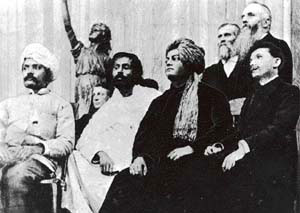
- Lecture given by Swami Vivekananda, 25 March 1896
- Anniversary lecture given by Sri Chinmoy, 25 March 1969.
There are subschools of Vedanta which differ in their view of the relationship between the individual soul and Brahman and whether Brahman can be viewed as a personal God with attributes.
- Advaita – first propounded by Sri Sankaracharya, which held that Brahman was the only reality, without attributes, and that all else was maya (illusion) preventing man from seeing the true nature of things
- Dvaita - which holds that God/Brahman takes personal form as Lord Vishnu or one of His incarnations. The individual soul is regarded as separate from God, and encouraged to cultivate bhakti yoga.
- Vishistadvaita - identified Brahman with Lord Vishnu, and holds that the individual soul is part of Brahman as opposed to Brahman; a midway point between Advaita and Dvaita.
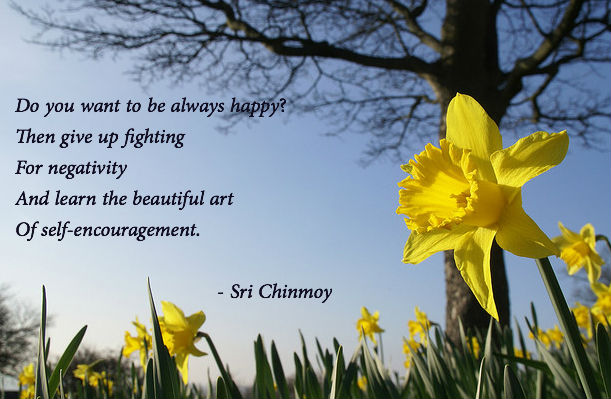
When we look up, the non-duality-Lord blesses us.
When we look forward, the duality-God embraces us.
Sri Chinmoy
more Vedanta resources coming soon…
Samkhya
The oldest of the systems: affirms a duality between spirit (purusha) and matter (prakriti). All physical events are prakriti; however all beings are purusha, and gradually evolve towards becoming more aware of their true self.
Purva Mimamsa
Concerned with upholding the authority of the Vedas, especially the rituals contained in the Mantras and Brahmanas (as upposed to Uttara Mimamsa which dealt with the Upanishads).